Despite the diversity of actions we’ve carried out this summer, the Action Factory has developed a unique ‘Action Factory’ style that rings through nearly all of our actions. Our style is usually comedic and gimmicky, and our message always positive. Rather than highlighting the often dismal political and scientific realities of today’s world, our actions are instead suggestive of the change we desire and the future we envision. At their core, almost all our actions affirm the now-famous cliché, “yes we can”:
- Yes, the Senate can pass a clean energy bill that is Harder, Better, Faster, and Stronger than the house ACES bill. We just have to teach our senators the 5% Allocation Workout routine, and they’ll buff up the climate bill in no time.
- Yes President Obama can go in person to Copenhagen and raise the stakes at the negotiating table. It will even be fun and he can enjoy himself by eating danishes while in Denmark for the negotiations.
And yet, it is important to step back every once and a while and remember another dimension of this battle. Our tone of optimism about fighting climate change often includes a mouthful of intangible jargon while leaving out an explanation for why we need a fair, ambitious, and binding global climate treaty so urgently. Climate change is not only a great opportunity to create jobs and new prosperity. It is also an urgent crisis that is already impacting many individual human lives and perpetuating current injustices.
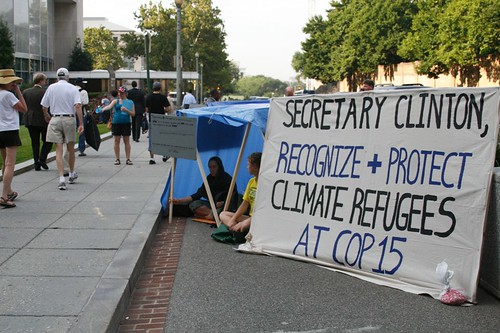
This week the Action Factory struck a new tone by setting up a refugee camp outside the state department. With our makeshift tents, blue tarps, and a reasonable ration of food packed in cardboard boxes, we put ourselves in the shoes of people displaced by climate change for over 24 hours.
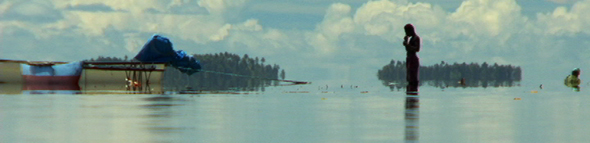
Our action gave us a brief taste of what it must have felt like to be Katrina climate refugees forced to leave their flooded homes. It allowed us to empathize ever so slightly with Sudanese refugees who have no choice but to flee from the violent Darfur conflict, which has it's roots in drought caused by climate change. We attempted to put ourselves in the shoes of Alaskan villagers forced to relocate as the permafrost that used to support their houses thaws, and try to understand the plight of Carteret islanders who have no choice but to leave their homes because growing crops has become nearly impossible with increased storm surges attributed to climate change.
It was hot, exhausting, and uncomfortable. I lay on my back awake on the pavement at 4:00 am and longed for my bed at home or even a light blanket to protect me from the early morning chill. And yet, of course, I had it easy, relatively speaking. I was a ‘refugee’ for a mere 24 hours, and within walking distance of air-conditioned shops where I was able to take time-outs for cold water, coffee, snacks, and other amenities.
For me, this week's climate refugee camp was especially meaningful because of another type of climate refugees on my mind. This past weekend I took a tour of long-wall coal mining sites in southwestern Pennsylvania with the Center for Coalfield Justice. During the tour, residents of Washington, PA spoke of contaminated water sources, damaged homes, and communities that are deteriorating. In long-wall mining, coal mining literally occurs directly underneath residents' homes and causes the land to sink down after the coal seam is removed. Many families have begun to move elsewhere as coal mining operations make life unbearable. As I sat in our refugee camp this week, I thought of the many communities impacted by coal mining throughout the US as while as of other impacted communities throughout the world. Given that climate change begins with resource extraction, it seems to me that these families who are displaced when they are pushed out by coal mining ought also to be considered a type of climate refugee. They represent yet another case of human displacement that is part of the climate change story, and I believe we stood in their shoes at our refugee camp outside the state department too. Their saddening stories make an even more compelling case for halting the use of dirty climate-changing fossil fuels immediately.
 Putting myself in the shoes of those forced to leave their homes due to flooding, contamination, drought, melting ice and war was crucial in bringing my focus to the individual and community level where climate impacts are felt. More than anything, this action was a wake-up call -- a poignant reminder of my privilege and all that I take for granted. I sincerely hope our refugee camp was a wake-up call to decision-makers at the state department as well. Much is at stake in this battle. While I prefer to look forward towards the new era of prosperity, health, and justice that we can usher in by taking strong action on climate, it is important to remember that climate impacts are already causing pain and turmoil for thousands of individuals worldwide. That’s why Secretary Clinton and Todd Stern need to act with genuine urgency if we are to get a Copenhagen Treaty that has any chance of fighting climate change and creating a more just world.